
Tuesday, December 3, 2013

Tuesday, September 17, 2013
Move First, Think Later by Dutch IM Willy Hendriks
Subtitled: Sense and Nonsense in Improving Your Chess
Many strong players have pointed out that one of the skills one must master is pattern recognition. It’s an important skill because when a master encounters a new position previous experience helps to find the right move. "In this book IM and experienced chess trainer Willy Hendriks presents a wealth of valuable, no-nonsense training material that will rock the chess instruction establishment," says publisher New in Chess.
The book is divided into 27 short chapters that cover a wide range of subjects such as psychology, pattern recognition, statistics, small plans, critical moments, chance, general rules, tactics versus strategy, time-trouble, etc.
Basically Hendriks attempts to debunk a number of myths about improvement and the short version is he comes down to the idea that, "You learn to play good chess by taking in good chess. There is no way to outsmart a diligent student with some clever way of thinking. There is no short-cut route to the best move by some revolutionary way of looking at the position. The strongest players are not following secret protocols." His point is that first looking at the characteristics of the position and then finding moves based upon that general characterization isn't getting to the essence of what produces quality play. That is, forget Jeremy Silman’s How to Reassess You Chess. He says, "moves are not only the outcome of some thinking process, they are very much the input, the starting point. It's not some clever thinking process that can help you find the best move in any position, but it's the enormous amount of knowledge that you bring to the board, good moves, mainly." (Emphasis mine)
Maybe he is right. Back in the sixties Ken Smith opined that you should play over hundreds and hundreds of unannotated games at 5-10 minutes per game while trying to guess the next move. Smith said you were going after quantity, not quality (that would come later) in an effort to learn pattern recognition. IM John Watson in Secrets of Modern Chess Strategy and Chess Strategy in Action said to look at the similarity between learning chess and a child learning a language: In language, direct experience, imitation, and accumulation of knowledge is what matters most, not learning formal grammatical rules and then applying them.
Hendriks discusses a wide variety of things like trial-and-error, pattern recognition, tactics versus strategy, time-trouble, planning, the illusion of general rules, the role of proverbs and maxims, free advice, critical moments, chance in chess, blunder-checking, tactics, the opening and strategy, games collections, puzzles, etc. And all the while, he tries to apply modern psychological theories and neurological research to chess.
Generally the book has been recommend to students in the 1400-2000 range.
Download a sample of the book.
Thursday, August 29, 2013
Chess Caps!!
I bought another baseball cap.

I have them for the Navy, Marine Corps and New York Yankees plus several hospitals and businesses, so why not chess? I have to wear a cap when I go outside because I have very fine hair and the lightest puff of wind will blow it all over the place. After you spend 20 minutes getting your hair looking just right you don’t want to go outside and get it all messed up, so that’s why I always wear a cap. Go down to the link on the left that says “Caps,” click on it and search for chess baseball caps and get yourself one. Keep your hair neat, let people know how smart you are because you play chess and maybe even pick up girls who are attracted to the intellectual type. I don’t know, but you really ought to consider getting one.

I have them for the Navy, Marine Corps and New York Yankees plus several hospitals and businesses, so why not chess? I have to wear a cap when I go outside because I have very fine hair and the lightest puff of wind will blow it all over the place. After you spend 20 minutes getting your hair looking just right you don’t want to go outside and get it all messed up, so that’s why I always wear a cap. Go down to the link on the left that says “Caps,” click on it and search for chess baseball caps and get yourself one. Keep your hair neat, let people know how smart you are because you play chess and maybe even pick up girls who are attracted to the intellectual type. I don’t know, but you really ought to consider getting one.
Technique in Chess by Gerald Abrahams
From the book’s blurb: A superb guide to the general concepts of chess technique and the methods for using technique to plan ahead. Early initiative and control of the center, translating an advantage into the middle game. 200 examples from actual play.
Abrahams (1907-1980) was a lawyer (barrister) in England and a very strong amateur player who published a number of books on chess. In this books he offers a collection of examples of methods of play he says are designed to help the novice although I think it would be too advanced for a true ‘novice.’ Maybe 1400-1600 would be more accurate.
Abrahams uses a lot of endgames for examples because he believed this is the area where the function of the pieces can be isolated and examined in more detail. However, he also uses a lot middlegame and complete games for examples.
Abrahams likens the discovery of strategy and technique to his discovery of prose. When he discovered prose, he realized he had speaking in prose all his life. Likewise, he believed many chess players already have some basic understanding of strategy, tactics and ideas but have difficulty expressing themselves on the board. I think this is true. While reading De Groot’s Thought and Choice in Chess I noticed that on occasion lower rated players looked at some of the same moves the GMs did, but usually rejected them out of hand. I thought that was odd and after some thought decided to begin limiting my candidate moves to the first 3-4moves that occurred to me. Over the years I gradually refined this technique as depicted in the following chart.
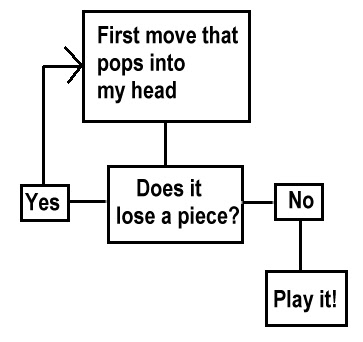
Technique in Chess is a fun book to read but like all chess books, it will take some dedication but the reward is that you will get some good, practical advice that is bound to improve your game and prepare you for various situations that will arise during the game.
BTW…if you don’t know descriptive notation I recommend learning it! If you don’t, you are missing out on some great old books. I learned it as a 10-year old, so how hard can it be? If you have to, print out the diagram shown in the Wikipedia article HERE.
Tuesday, August 13, 2013
Not a Chess Book but…
maybe worth reading!
Why do people dodge responsibility when things fall apart? Why the parade of public figures unable to own up when they screw up? Why the endless marital quarrels over who is right? Why can we see hypocrisy in others but not in ourselves? Are we all liars? Or do we really believe the stories we tell?
Backed by years of research and delivered in lively, energetic prose, Mistakes Were Made (But Not by Me) offers a fascinating explanation of self-deception—how it works, the harm it can cause, and how we can overcome it.
Review from O Magazine:
"A revelatory study of how lovers, lawyers, doctors, politicians--and all of us--pull the wool over our own eyes. The politician who can’t apologize, the torturer who feels no guilt, the co-worker who’ll say anything to win an argument--in case you’ve ever wondered how such people can sleep at night, a new book by Carol Tavris and Elliot Aronson supplies some intriguing and useful insights.
Thanks, in part, to the scientific evidence it provides and the charm of its down-to-earth, commonsensical tone, Mistakes Were Made is convincing. Reading it, we recognize the behavior of our leaders, our loved ones, and--if we’re honest--ourselves, and some of the more perplexing mysteries of human nature begin to seem a little clearer. By the book’s end, we’re far more attuned to the ways in which we avoid admitting our missteps, and intensely aware of how much our own (and everyone’s) lives would improve if we--and those who govern and lead us--understood the power and value of simply saying, ''I made a mistake. I'm sorry.''”
...."and those who govern and lead us--understood the power and value of simply saying, ''I made a mistake. I'm sorry.''” Fat chance!
Friday, August 2, 2013
Chess Tactics for Champions: A step-by-step guide to using tactics and combinations the Polgar way by Susan Polgar
In any case, what we have here is yet another tactics book. In the introduction she writes, a tactic is “a tool that helps us gain some kind of advantage. It can lead to material gain or even to checkmate” and she goes on to assert that a player “can get a lot further by being very good in tactics and have only a basic understanding of strategy.” I really must take umbrage with this last statement. Openings have always been a favorite of authors peddling easy wins and these days it’s tactics. I’m not saying tactics aren’t important, but in days gone by, some claimed you couldn’t teach tactics; you were born with the ability to spot them! But guys like Renaud & Kahn, Vukovic, Euwe and Pachman wrote some pretty good books on tactics. Still, back when Botvinnik was “the man” in the chess world, there was a glut of books on strategy and the players who grew up on strategy books by Euwe, Pachman, Fine, et al played some pretty good chess. By the way, I think sometimes lower rated players fail to make a distinction between blunders and tactics. Some players say they are weak tactically and lose pieces and fall into simple mates when in reality they are just overlooking the fact that they are missing obvious replies by their opponents. Hanging your Q to a N fork or overlooking a one move mate is not failing to spot a tactic; it’s just an outright blunder that could have been avoided by looking at the entire board.
This book consists of an array of exercises, organized by tactical motif and supplemented by examples, but generally descriptions are somewhat lacking. With each topic, she includes a short description of the tactic followed by an example from one of her own games and then jumps right into a set of problems to solve. Some players find the arrangement a major flaw because the tactics are grouped by motif. Personally, I don’t think that's a flaw at all. It's always obvious what kind of tactical solution you are looking for and the ability to recognize patterns and tactical motifs is fundamental for understanding combinations. Her presentation generally makes it fairly easy to find candidate moves that match the theme of the chapter and my understanding is that the Polgar sisters learned by repetition so this format makes sense. But, what would be helpful is a guide to spotting motifs that make combinations possible. C.J.S. Purdy has written some good stuff on this subject and you can download my synopsis, Hints on How to Study Chess for the Most Rapid Improvement here.
Chapters: Forks and Double Attacks, Deflection and Removing the Guard, Discoveries, Double Checks, Skewers, Trapping Pieces, Decoys, Intermediate Moves, Pawn Promotions, Back Rank, Destroying the Castled King’s Position, King Chase, Two-movers, Three Movers, Four Movers, Game Saving Combinations, Perpetual Checks, Stalemates, Trap and Counter Traps, Sibling Positions, and 25 Famous Combinations
The back cover says that the book is for "intermediate to advanced" players. That’s probably about right. This definitely shouldn't be your first tactics book if you are rated below, say, 1600, but if you fall between 1600 - 1800, it's worthwhile.
Tuesday, July 9, 2013
The Art of Checkmate
Purdy complained that the translation of this book reaches is an all-time low. Almost every page has sentences that are not translations at all, or even paraphrases but are thoughts of the translator’s. According to the translator, the authors wrote, “The following game was played between two second-rate players who, nevertheless, seem to be pretty well versed in the opening theory.” “Second-rate” is offensive; what the authors actually wrote was, “…amateurs of the second rank—but amateurs of some erudition, for, as we are about to see…” The translator says Taubenhaus was a “second-rate” master.” The authors wrote “maitre de deuxieme plan.” A better translation is, “second-rank master” or “minor master.”
23 mating situations are classified, including Legal's pseudo-sacrifice, the double check, smothered mate, Greco's mate, the Corridor mate, many others. 127 games by Tartakower, Janowski, Rubinstein, Blackburne, others, illustrating positional maneuvers leading to these mates. Review quizzes test progress.
People complain about it being in the old descriptive chess notation, but anyone of at least below average intelligence can learn descriptive notation in about 10 minutes. The ability to see patterns is paramount and this book is one of the best at teaching one how to read the board. Go through the patterns again and again and eventually you will finally understand them to the point that when you see them you can apply them in your own games. In my college days I had trouble factoring binomial equations...just couldn't seem to get it. Then, I wrote out ONE equation on a slip of paper and whenever I had a couple of spare minutes, I pulled out the paper and worked the problem. Eventually, after a couple of days and who knows how many time, something clicked and I could work any problem. Maybe it would work that way with chess tactics, too?!
Friday, June 28, 2013
Best Buy on Fritz!
In my opinion the Fritz GUI is absolutely the best and for
the price, you can’t beat it. Some
people have a little trouble using it because they are unfamiliar with
navigating through it and using all its features, but all the questions on how
to use Fritz can be found HERE.

Don’t use the Fritz 12 engine that comes with it though. In fact, don't use any of the Fritz engines. the reason is because other free
engines are stronger. Go to my Blog and
search for engines you can download HERE.
Thursday, June 27, 2013
Thursday, May 30, 2013
What Would YOU Play?
This is my latest pdf book. It contains 60 positions from GM games for you to
analyze then decide what you would play.
Large diagrams, one per page. On
the following page are the top five engine lines along with the GM comments and the
actual game continuation with brief notes.
The idea of the format is that when you are sitting at the board you won’t be given any
hints; no one is going to tell you there is a combination that wins a piece or
leads to mate that is available. If there is a sound tactical solution
hiding in the position it will up to you to find it. If there isn’t, you will have to decide on a
reasonable plan of action. Thus, the
positions in this book are the kind you would actually face in an over the
board game and it is up to you to decide whether to play a tactical or
positional line. Just like in a real
game...no hints are given!
There is also a guide, mostly derived from suggestions by
C.J.S. Purdy, detailing how to analyze every position you face.
Also included at the end of the book is a guide containing advice
gleaned from the writings of such well known players as Jonathan Rowson, Steven
Ham and Robin Smith on how to conduct a proper analysis using an engine. 60 positions, 140 pages.
It is available for download for $1.50 at AuthorStand. Note: You must be a member to download from
AuthorStand…it’s
free! At AuthorStand you can
download thousands of pdf books by unknown authors on many different
subjects. Prices range from free and up.
Also available: Lone Pine, a series of tournaments
held from 1971 to 1981 that were sponsored by millionaire Louis D. Statham and
often drew the world's top players. This book has 422 pages of games that
can, if desired, be copied and pasted into a chess engine for analysis, or just
played over for enjoyment - FREE
Here is a sample that was not included in the book:
 |
| White to play |
Petrosian,Tigran -
Gligoric,Svetozar Zurich, 1953
Gligoric had employed a
new idea in the K-Indian where he tried to hasten his K-side break despite the
fact White had castled on the other side.
After a series of errors by both sides Gligoric misses a chance to win
the game and Petrosian regains his winning position.
37.Ne2??
A time pressure error
that gives Black new chances.
1)
37.a3 Rc5 38.Ka1 Ra5 39.Ne2 Rda4 40.Rxc7 Qb8 41.R7c2 Ra8 42.Nc3 4.10
2)
37.Qe1 Rb4 38.Nd1 Raa4 39.Nf2 Rb7 40.Qc3 Qe8 41.b3 Rd4 42.Be2 3.75
3)
37.Qh2 Rb4 38.Bd3 Bh5 39.Rg1 Ra8 40.Qh3 Qc8 41.Qf1 3.71
4)
37.Be2 Rb4 38.Rg1 Rb8 39.h5 Bf7 40.Qh2 Qf6 41.h6 Rg8 42.Rxg8+ 3.63
5)
37.b3! According to Najdorf this is the correct move, but he gave no follow-up.
37...Rb4 38.Bd3 Qe7 39.Rg1 Rb8 40.Qh2 Bf7 41.Qh3 Rc5 42.h5 c6 43.h6 Rg8
44.Rxg8+ Bxg8 45.dxc6 Rxc6 46.Nd5 3.31
37...Rda4??
Missing his one chance
in the whole game! 37...Rxe4!!
Fantastic. What's the point? You'll see. 38.h5 (38.fxe4?? Nxe4 39.Qe1 Qxd5
40.b3 (40.a3 Nd2+ The point! 41.Ka1 Nb3+ 42.Kb1 Nxc1 43.Kxc1 and
it's Black who is winning.) 40...Nd2+ 41.Kb2 (41.Ka1 Nxb3+ 42.Kb2
Rxa2+ 43.Kxa2 Nxc1+ 44.Ka1 Qa8+ 45.Kb1 Qa2+ 46.Kxc1 Qxc2#) 41...Rxa2+
42.Kxa2 Qxb3+ 43.Ka1 Qa3+ 44.Ra2 Nb3#) 38...Bf5! and Black enjoys the
advantage. (38...Bxh5 39.fxe4 Nxe4 40.Qe1 Qxd5 41.b3 does not work
because the check on d2 is not available because the B is no longer on the
b1–h7 diagonal.
38.Nc3 Rd4 39.b3 Qb8
40.h5 Bxh5 41.Qh4 1–0
Black resigned because if 41...Qe8 (or 41...Bg6
42.Qf6+ Kg8 43.Bh3 Nf7 44.Be6 Qf8 45.Ne2 winning) 42.Ne2 Rxe4
43.Rxc7 and wins.
Friday, April 19, 2013
Random House
Random House
categories: Biographies/Memoirs, Body, Mind and Spirit, Business/Economics, Classics, Crafts & Hobbies, Education, Fiction/Literature, Games, Mystery, Religion/Spirituality, Science Fiction, Sports and many other subjects. Very limited chess selection, but if you like books, it's a great site to just browse.
Chess Equipment Sale!
The Chess Store has new discounts and is offering 10% OFF with the coupon code SPRING10 on all products until 30th of April!
The Chess Store Spring Sale


Thursday, April 11, 2013
Chess Assistant 13
Chess Assistant 13, starter package with Houdini 3 allows you to
manage games and databases, play chess online, analyze games and, of course,
play against the computer.
The Starter Package includes Houdini 3, Chess Opening Encyclopedia
2012, a powerful search system, a Tree mode, databases of 5.6 million games up
to November 1, 2012 and Premium Game Service 2013 (3000 new games each week by
Internet). Houdini 3 supports up to 6 cores and 4 GB of hash and is compatible
with a variety of interfaces.
There
is a Professional version of Chess Assistant that offers the PRO version of
Houdini 3 which supports up to 32 cores and 32 GB of hash
and additional tools, but the basic package is fine for most all of us. The Opening Encyclopedia contains theoretical material on all openings including over 8000 annotations from GM Kalinin and 40 million evaluations by the strongest engines. The Opening Tables allows you to create, maintain and studying your opening repertoire and it is fully customizable with your own moves and evaluations.
 |
| Click to enlarge |
You can download Chess Assistant 12 Lite which provides you with most basic functions of Chess Assistant for free HERE.
Friday, March 29, 2013
Zagreb Chess Set

Between
7th September 1959 and 29th October 1959, eight of the strongest GMs in the
world met in the Yugoslav cities of Bled, Zagreb and Belgrade for the right to
a challenge Mikhail Botvinnik for the World Championship. The tournament consisted of 28 rounds, each player
facing the others four times.
The
eight players in this competition had qualified as follows:
ex-World
Champion Vasily Smyslov.
second
place finisher in the previous Candidates Tournament - Paul
Keres.
The
other six places were determined by an Interzonal tournament, held in 1958 in Portorož,
Yugoslavia - Mikhail Tal, Svetozar Gligorić, Tigran Petrosian, Pal Benkö,
Fridrik Ólafsson and Robert Fischer.
Ex-World Champion Vasily Smyslov and Paul Keres were considered strong favorites with Tigran Petrosian being given an outside chance. Of the non-Soviet players Gligorić was considered the strongest but not a likely victor. Olafsson and Benko had only recently been awarded the GM title and were not considered serious contenders. Everyone’s eye was on Bobby Fischer and it was expected he would play the role of spoiler in a few games, but he was not considered a threat to win the tournament. Tahl won the event one and a half points despite losing 3 out of 4 games to the unfortunate perennial runner-up, Paul Keres.
In commeration of this event The House of Staunton offers the Zagreb '59 Series set which is a reproduction of one of the most popular sets used in international tournaments durign the 1950s and 1960s. This my set of choice and as usual, the set from HOS comes with two extra Queens.
 |
| Tartajubow's Chess Set |
Friday, March 22, 2013
The Greatest Secrets of Bobby Fischer by Nenad Nesh Stankovic
Subtitled
The Final Truth About the Greatest Chess
Player of All Time. I bought this book the other day by accident. Ads for the book (in several languages)
appear all over the Internet and it even has a Facebook page. All this hoopla
initially made me think… sales hype for a real potboiler that’s not worth
reading. The book claims that for the
first time, some of Fischer's most intimate confessions and thoughts are told
and it focuses on the ideas which lead Fischer toward “misunderstanding,
rejection hatred and contempt.”
After reading the review about it I decided to download it, realizing too late that my $25 gift card was for Amazon, not Nook. Oh, well. I have only read the first few chapters, but find the book very hard to put down.
Stankovic was essentially Fischer’s personal assistant when Fischer arrived in Yugoslavia to prepare for his match with Spassky. Stankovic was more patient with Fischer’s twisted personality and petty, irrational demands than I would have ever been and I commend him for that!
Just for example, the author describes how that when he arrived in Yugoslavia, Fischer’s clothes were worn and tattered and he had to have new ones tailored at the expense of Mr. Jezdimir Vasiljevic, the sponsor. After endless searching, Stankovic finally found a tailor to Fischer’s liking, an elderly, well-known female. Fischer drove the poor woman to tears over the next few months. At each fitting for his shirts he would find something wrong and make new demands. The waist was too tight. The height of the collars was repeatedly adjusted and they were either too limp or too stiff. On and on it went. Then there were his haircuts and beard trimmings. They had to search all over Belgrade to find a barber that only used a comb and scissors because Bobby didn’t like electronic clippers. The Fischer would sit in the shop for an hour or so to observe the barbers’ work before finally selecting one. I would have told him to go pound salt, but everybody kowtowed to his demands.
Of course the real meat of the book is the match with Spassky. I can’t say much about that as I haven’t gotten that far yet. What I can tell you is that so far the author has made Fischer come alive and it feels like I am actually in the presence of a disgusting, loutish, jackass whose one redeeming characteristic is that he was a great chess player. Fischer is like a gory accident scene. Repulsive, but you can’t look away.
For $6.99 for the Nook/Kindle edition, how can you go wrong?
Addendum:
Early the next morning Stankovic was approached by Fischer who was still in his pajamas and bathrobe and white as a sheet. He explained that the two men in the lobby the night before were sent to kill him. Fischer’s “proof:”
After reading the review about it I decided to download it, realizing too late that my $25 gift card was for Amazon, not Nook. Oh, well. I have only read the first few chapters, but find the book very hard to put down.
Stankovic was essentially Fischer’s personal assistant when Fischer arrived in Yugoslavia to prepare for his match with Spassky. Stankovic was more patient with Fischer’s twisted personality and petty, irrational demands than I would have ever been and I commend him for that!
Just for example, the author describes how that when he arrived in Yugoslavia, Fischer’s clothes were worn and tattered and he had to have new ones tailored at the expense of Mr. Jezdimir Vasiljevic, the sponsor. After endless searching, Stankovic finally found a tailor to Fischer’s liking, an elderly, well-known female. Fischer drove the poor woman to tears over the next few months. At each fitting for his shirts he would find something wrong and make new demands. The waist was too tight. The height of the collars was repeatedly adjusted and they were either too limp or too stiff. On and on it went. Then there were his haircuts and beard trimmings. They had to search all over Belgrade to find a barber that only used a comb and scissors because Bobby didn’t like electronic clippers. The Fischer would sit in the shop for an hour or so to observe the barbers’ work before finally selecting one. I would have told him to go pound salt, but everybody kowtowed to his demands.
Of course the real meat of the book is the match with Spassky. I can’t say much about that as I haven’t gotten that far yet. What I can tell you is that so far the author has made Fischer come alive and it feels like I am actually in the presence of a disgusting, loutish, jackass whose one redeeming characteristic is that he was a great chess player. Fischer is like a gory accident scene. Repulsive, but you can’t look away.
For $6.99 for the Nook/Kindle edition, how can you go wrong?
Addendum:
“In the overall gloom of his spirit and tempest of thought,
Bobby became irrational to the utmost in practical matters that were not his
strong suit even in his ‘lucid’ days." - Stankovic
One day while the author and Fischer were sitting in a hotel
lobby in Belgrade two thirty-ish Czech men were sitting nearby laughing and
talking. Stankovic asked Fischer if they
were disturbing him and Fischer replied, “No, it’s alright.” Finally the two of them turned towards
Fischer and asked, “Are you Bobby Fischer?” to which he replied, “I am.” The two men and Fischer then had a short
conversation and one of them told Fischer that when they left Prague their
neighbor, a Mr. Steelman who was a big Fischer fan, asked that if the run into
Fischer to give him his best regards.Early the next morning Stankovic was approached by Fischer who was still in his pajamas and bathrobe and white as a sheet. He explained that the two men in the lobby the night before were sent to kill him. Fischer’s “proof:”
He did not know this Steelman; he surely did not exist
To Fischer the message was clear: “Steel” and “man.” meaning
the men were sent to “pump me full of lead.”
“They will shoot me.”
They had said they were from Czechoslovakia, “the land that
is no more. Therefore they want me gone,
too.”
He asked Stankovic to find them and bring them to him. Stankovic said Fischer was looking at him
with eyes wide open and gesturing for silence so nobody would hear them or
record anything. Stankovic did what he felt was his duty and
followed up on Fischer’s request to try and locate the men even though nothing illegal had taken place; it was becoming necessary for him to protect Fischer from “demons
and spooks.”
Friday, March 15, 2013
The Magic Tactics of Mikhail Tal by Karsten Muller
Although
he died in 1992 Tahl remains a favorite with players everywhere. Known as The Magician from Riga, Tahl
took the chess world by storm and in 1961 and at the age of twenty-three won
the world championship. Even though his sacrifices were not always perfect, they were spectacular and
the problems he set his opponents put them under tremendous pressure. Most of the time they would eventually crack.
In this book Muller and journalist Raymund Stolze
have selected one hundred exercises highlighting Tahl’s genius. Most of them have not been seen before.
The book can’t really
by classified as a book of problems. The Prologue was written by Tahl himself and
he discusses the differences between knowledge and what he called "poetry.”
That is followed by 21 pages written by Botvinnik titled, "Reflections on
Mikhail T.”
Chapter 1 has a list
of the "golden rules of attack” followed by 40 exercises and every diagram
is followed by a few paragraphs that discuss the circumstances in which the
game was played. It is very helpful that
the solutions are both in analysis form and prose! Another great feature is that Mueller begins each section
with 2 or 3 annotated games that illustrate the theme. All together there are 18 annotated games and
about a dozen other game fragments.
Chapters are titled Correct
Sacrifices, Speculative Sacrifices, Correct Way to Defend Against the Magician and
there is an epilogue by Tahl. I’ve had a couple of
books on Tahl and this one is my new favorite.
Thursday, February 21, 2013
Chess Opening Essentials by Stefan Djuric et al
4 volumes - Winner of the Italian Chess Federation’s Golden Award.
These books are both primers and opening references that provide essential knowledge on all chess openings. The authors explain the basic plans and ideas for both sides in a way that will help develop a solid understanding of fundamental opening ideas. They explain the similarities with other openings as well as the differences and detail various middlegame plans that apply after the opening has ended.
Vol. 1 covers 1.e4
Vol. 2 covers 1.d4 d5 / 1.d4 various / Queen Gambits
Vol. 3 covers the Indian Defenses
Vol. 4 covers 1.c4 / 1.Nf3 / Other First Moves
I would recommend that, after selecting what openings you want to play, you thoroughly review the material in the books then collect a database of master games with those openings. Play over them with a careful eye to how the games flow out of the openings and the types of endings that may develop. After you analyze 25 or so master games with your chosen opening you should have begun to develop a feel for how it should be played.
Books for Dummies
I like these books for dummies. They don’t make you an expert in anything but what they will do is give you a good, simple overview of the subjects covered. This book is no different. You won’t find masters using it, but if you are new to chess and want to learn opening basics or if you simply want to learn a new opening, Chess Openings for Dummies is a pretty good start. Disregard the hype that claims the book gives you tips and techniques for winning games from the very first move you make. That’s nonsense, but the claim that the book is a friendly, helpful guide that provides you with easy-to-follow and step-by-step instructions on the top opening strategies and gives you the tools you need to develop your own line of attack…that part is true.
Some opening books like Modern Chess Openings feature variation after variation in column after column. My personal opinion is that MCO and books like it have outlived their usefulness. Other books specialize on specific openings or even variations and using them requires caution; some are good, some are downright bad. The nice thing about Chess Openings for Dummies is that it gives you a good overview of the openings you’ll most likely run into in practical play as well as good advice on what openings it makes sense for you to use in your own play. A big plus is Eade also gives you the ideas behind the openings and this is probably the most important part of the book. If you understand the ideas then, when your opponent deviates, you will have a basis on which to make a judgment as to the merits of his move. You will also have some idea of how to take advantage of his move if it is not part of the correct overall strategy of the opening being played.
All the major openings are covered and well organized: Open Games, Semi-Open Games, Closed Games, Semi-Closed Games and Flank openings are covered in depth in their own section. And…very important…there are the examples of master games played with the openings. This is vital because you really need to see complete games with each opening. Eade gives an example of when the opening is successful and when it isn’t. Highly recommended.
Thursday, January 31, 2013
Zurich 1953 by Najdorf
This book came highly recommended by one of my Blog readers. Russell
Enterprises has done chess players everywhere a favor in printing Najdorf’s
book on this great tournament, originally available only in two volumes in
Spanish. Why another copy of a great
tournament of long ago when we already had Bronstein’s monumental work on the
tournament? Good question.
Bronstein
noted that he was responsible for the analysis in his book but the text was
mostly by Boris Vainstein. In the book “Secret Notes", by Bronstein and
Sergey Voronkov which Bronstein wanted published only after his death, he
talked about how Zurich 1953 was fixed. He said that it was the most embarrassing
moment of his chess career and the KGB monitored the event and instructed the
players to arrange "rest draws" or even losses against the
"chosen winner,” who was Smyslov as long as Reshevsky had the lead.
In
my Blog I gave the game Keres vs. Boleslavsky where it looked like Boleslavsky
threw the game to Keres. Nobody, not
even Najdorf, was able to explain Boleslavsky’s play. That game was played in the sixth round and
as a result Keres and Smyslov moved to within a half point of the leader,
Reshevsky. According to Bronstein a KGB
agent even asked him, "Do you really think you've come here to play
chess". As a result of this tournament Bronstein confessed that he never
did forget the shame that he felt. "We were all puppets"...
This English translation of Najdorf’s book includes
all 210 games with his notes, all the original introductory material,
biographical sketches of the players, lots of diagrams, and pictures. There is an introduction by Yuri Averbakh, who
along with Mark Taimanov are the last surviving participants, and a foreword by
GM Andrew Soltis.
What makes this book so great is Najdorf’s vivid prose and his firsthand account of this great event. Najdorf had a rare combination of skills; not only was he a great player, but he had the ability to explain things in a clear and entertaining way.
What makes this book so great is Najdorf’s vivid prose and his firsthand account of this great event. Najdorf had a rare combination of skills; not only was he a great player, but he had the ability to explain things in a clear and entertaining way.
One thing
about this translation that is greatly appreciated is the work of the translator, Taylor
Kingston. He didn’t mess with the
original but made a translation that is faithful to the original and managed
to capture Najdorf’s wit and style.
So, why
do we really need this new translation of a tournament played in 1953? Forget about the fact that the tournament had
the greatest players of the day or it may have been fixed or that Najdorf was a
great writer and that the games were instructive, etc., etc. It’s fun
just to watch them play and read Najdorf’s notes! Read sample
This book
is also available for the Nook and Kindle.
Saturday, January 26, 2013
Elements of Positional Evaluation: How the Chess Pieces Get Their Power by Heisman
I’ve been a fan of National Master Dan Heisman ever since I discovered his columns online years ago. There are very few players who make things look so simple it makes you wonder why everybody isn’t a master; Heisman is one; CJS Purdy was another.
In these days of seeing recommendations that you need to study tactics until you puke books on strategy are scarce. This book was originally written the mid-seventies on a typewriter. Heisman said of the original that it described the values and relationship between the pieces functioned in evaluating positions but it was not a beginners’ book. This latest edition has come a long way and Heisman recommends it for players rated between 800 and 1800. Personally, I think anybody rated below master would benefit from the book because it’s never a bad idea to review what you think you know, not to mention what you have forgotten.
The contents are:
Background of Positional Knowledge
Elements
Psuedo-Elements
Pieces in Relation to the Elements
Static Features Elements
Miscellaneous Applications of the Theory
Epilogue
Appendix: Illustrative Games
Heisman starts off with an interesting history of positional theory then moves on to piece development and hypermodern theory. His discussion of the conflict between schools of thought, such as between Nimzovich's hypermodern theory and Tarrasch's dogmatic classical style is most interesting and instructive. Even when you are discussing strategy though, tactical motifs must be considered and Heisman covers basic motifs such as pins, combinations, sacrifices, and other tactical issues. His explanation of double pawns, development, static and dynamic positions, etc. can’t help but make things crystal clear.
This whole area of strategy is often unappreciated by a lot of players, but answering the question “who stands better, and by how much?" is essential if one is going to understand the position because, barring a freak accident, tactical solutions either won’t be possible or else they will be unsound in most of the positions we encounter. And this is precisely where I have seen a lot of lower rated players get into trouble. Thinking the only way to win is to do so tactically, they will often play an unsound sacrifice then watch there so called attack fizzle out and be left a piece down. Can't tell you how many free Bishop's I've been handed due to the old Bxf7+ trick even if it wasn't justified.
When no sound combination is possible, you have to have some idea of who is better and why or you will just be shifting plastic to no purpose. These days, as compared to way back when, positional evaluations have changed, especially in regards to positional sacrifices. I can remember when positional sacrifices were made for no immediate material gain or no direct attack it left us all flabbergasted! But then the Benko Gambit (Volga Gambit to some), where Black sacrificed a Pawn for positional compensation created a sensation. GM Jim Tarajn's games used to fascinate me because he seemed to make exchange sacrifices a lot. Nowadays you see GMs routinely playing like that. Of course, they also play a lot of moves that look anti-positional and if Tarrasch thought some of Nimzovich’s ideas were bizarre, he would be appalled today. One thing Heisman covers very well is explaining the value of pieces varies depending on mobility, coordination, etc. IM Larry Kaufman’s discussion of this issue can be read HERE.
Bottom line: If you are looking for a better understanding of how to evaluate positions get this book! Make sure you get the FOURTH Edition.
Subscribe to:
Posts (Atom)