
Friday, April 19, 2013
Random House
Random House
categories: Biographies/Memoirs, Body, Mind and Spirit, Business/Economics, Classics, Crafts & Hobbies, Education, Fiction/Literature, Games, Mystery, Religion/Spirituality, Science Fiction, Sports and many other subjects. Very limited chess selection, but if you like books, it's a great site to just browse.

Chess Equipment Sale!
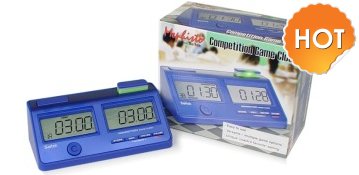
The Chess Store has new discounts and is offering 10% OFF with the coupon code SPRING10 on all products until 30th of April!
The Chess Store Spring Sale


Thursday, April 11, 2013
Chess Assistant 13
Chess Assistant 13, starter package with Houdini 3 allows you to
manage games and databases, play chess online, analyze games and, of course,
play against the computer.
The Starter Package includes Houdini 3, Chess Opening Encyclopedia
2012, a powerful search system, a Tree mode, databases of 5.6 million games up
to November 1, 2012 and Premium Game Service 2013 (3000 new games each week by
Internet). Houdini 3 supports up to 6 cores and 4 GB of hash and is compatible
with a variety of interfaces.
There
is a Professional version of Chess Assistant that offers the PRO version of
Houdini 3 which supports up to 32 cores and 32 GB of hash
and additional tools, but the basic package is fine for most all of us. The Opening Encyclopedia contains theoretical material on all openings including over 8000 annotations from GM Kalinin and 40 million evaluations by the strongest engines. The Opening Tables allows you to create, maintain and studying your opening repertoire and it is fully customizable with your own moves and evaluations.
 |
| Click to enlarge |
You can download Chess Assistant 12 Lite which provides you with most basic functions of Chess Assistant for free HERE.
Friday, March 29, 2013
Zagreb Chess Set

Between
7th September 1959 and 29th October 1959, eight of the strongest GMs in the
world met in the Yugoslav cities of Bled, Zagreb and Belgrade for the right to
a challenge Mikhail Botvinnik for the World Championship. The tournament consisted of 28 rounds, each player
facing the others four times.
The
eight players in this competition had qualified as follows:
ex-World
Champion Vasily Smyslov.
second
place finisher in the previous Candidates Tournament - Paul
Keres.
The
other six places were determined by an Interzonal tournament, held in 1958 in Portorož,
Yugoslavia - Mikhail Tal, Svetozar Gligorić, Tigran Petrosian, Pal Benkö,
Fridrik Ólafsson and Robert Fischer.
Ex-World Champion Vasily Smyslov and Paul Keres were considered strong favorites with Tigran Petrosian being given an outside chance. Of the non-Soviet players Gligorić was considered the strongest but not a likely victor. Olafsson and Benko had only recently been awarded the GM title and were not considered serious contenders. Everyone’s eye was on Bobby Fischer and it was expected he would play the role of spoiler in a few games, but he was not considered a threat to win the tournament. Tahl won the event one and a half points despite losing 3 out of 4 games to the unfortunate perennial runner-up, Paul Keres.
In commeration of this event The House of Staunton offers the Zagreb '59 Series set which is a reproduction of one of the most popular sets used in international tournaments durign the 1950s and 1960s. This my set of choice and as usual, the set from HOS comes with two extra Queens.
 |
| Tartajubow's Chess Set |
Friday, March 22, 2013
The Greatest Secrets of Bobby Fischer by Nenad Nesh Stankovic
Subtitled
The Final Truth About the Greatest Chess
Player of All Time. I bought this book the other day by accident. Ads for the book (in several languages)
appear all over the Internet and it even has a Facebook page. All this hoopla
initially made me think… sales hype for a real potboiler that’s not worth
reading. The book claims that for the
first time, some of Fischer's most intimate confessions and thoughts are told
and it focuses on the ideas which lead Fischer toward “misunderstanding,
rejection hatred and contempt.”
After reading the review about it I decided to download it, realizing too late that my $25 gift card was for Amazon, not Nook. Oh, well. I have only read the first few chapters, but find the book very hard to put down.
Stankovic was essentially Fischer’s personal assistant when Fischer arrived in Yugoslavia to prepare for his match with Spassky. Stankovic was more patient with Fischer’s twisted personality and petty, irrational demands than I would have ever been and I commend him for that!
Just for example, the author describes how that when he arrived in Yugoslavia, Fischer’s clothes were worn and tattered and he had to have new ones tailored at the expense of Mr. Jezdimir Vasiljevic, the sponsor. After endless searching, Stankovic finally found a tailor to Fischer’s liking, an elderly, well-known female. Fischer drove the poor woman to tears over the next few months. At each fitting for his shirts he would find something wrong and make new demands. The waist was too tight. The height of the collars was repeatedly adjusted and they were either too limp or too stiff. On and on it went. Then there were his haircuts and beard trimmings. They had to search all over Belgrade to find a barber that only used a comb and scissors because Bobby didn’t like electronic clippers. The Fischer would sit in the shop for an hour or so to observe the barbers’ work before finally selecting one. I would have told him to go pound salt, but everybody kowtowed to his demands.
Of course the real meat of the book is the match with Spassky. I can’t say much about that as I haven’t gotten that far yet. What I can tell you is that so far the author has made Fischer come alive and it feels like I am actually in the presence of a disgusting, loutish, jackass whose one redeeming characteristic is that he was a great chess player. Fischer is like a gory accident scene. Repulsive, but you can’t look away.
For $6.99 for the Nook/Kindle edition, how can you go wrong?
Addendum:
Early the next morning Stankovic was approached by Fischer who was still in his pajamas and bathrobe and white as a sheet. He explained that the two men in the lobby the night before were sent to kill him. Fischer’s “proof:”
After reading the review about it I decided to download it, realizing too late that my $25 gift card was for Amazon, not Nook. Oh, well. I have only read the first few chapters, but find the book very hard to put down.
Stankovic was essentially Fischer’s personal assistant when Fischer arrived in Yugoslavia to prepare for his match with Spassky. Stankovic was more patient with Fischer’s twisted personality and petty, irrational demands than I would have ever been and I commend him for that!
Just for example, the author describes how that when he arrived in Yugoslavia, Fischer’s clothes were worn and tattered and he had to have new ones tailored at the expense of Mr. Jezdimir Vasiljevic, the sponsor. After endless searching, Stankovic finally found a tailor to Fischer’s liking, an elderly, well-known female. Fischer drove the poor woman to tears over the next few months. At each fitting for his shirts he would find something wrong and make new demands. The waist was too tight. The height of the collars was repeatedly adjusted and they were either too limp or too stiff. On and on it went. Then there were his haircuts and beard trimmings. They had to search all over Belgrade to find a barber that only used a comb and scissors because Bobby didn’t like electronic clippers. The Fischer would sit in the shop for an hour or so to observe the barbers’ work before finally selecting one. I would have told him to go pound salt, but everybody kowtowed to his demands.
Of course the real meat of the book is the match with Spassky. I can’t say much about that as I haven’t gotten that far yet. What I can tell you is that so far the author has made Fischer come alive and it feels like I am actually in the presence of a disgusting, loutish, jackass whose one redeeming characteristic is that he was a great chess player. Fischer is like a gory accident scene. Repulsive, but you can’t look away.
For $6.99 for the Nook/Kindle edition, how can you go wrong?
Addendum:
“In the overall gloom of his spirit and tempest of thought,
Bobby became irrational to the utmost in practical matters that were not his
strong suit even in his ‘lucid’ days." - Stankovic
One day while the author and Fischer were sitting in a hotel
lobby in Belgrade two thirty-ish Czech men were sitting nearby laughing and
talking. Stankovic asked Fischer if they
were disturbing him and Fischer replied, “No, it’s alright.” Finally the two of them turned towards
Fischer and asked, “Are you Bobby Fischer?” to which he replied, “I am.” The two men and Fischer then had a short
conversation and one of them told Fischer that when they left Prague their
neighbor, a Mr. Steelman who was a big Fischer fan, asked that if the run into
Fischer to give him his best regards.Early the next morning Stankovic was approached by Fischer who was still in his pajamas and bathrobe and white as a sheet. He explained that the two men in the lobby the night before were sent to kill him. Fischer’s “proof:”
He did not know this Steelman; he surely did not exist
To Fischer the message was clear: “Steel” and “man.” meaning
the men were sent to “pump me full of lead.”
“They will shoot me.”
They had said they were from Czechoslovakia, “the land that
is no more. Therefore they want me gone,
too.”
He asked Stankovic to find them and bring them to him. Stankovic said Fischer was looking at him
with eyes wide open and gesturing for silence so nobody would hear them or
record anything. Stankovic did what he felt was his duty and
followed up on Fischer’s request to try and locate the men even though nothing illegal had taken place; it was becoming necessary for him to protect Fischer from “demons
and spooks.”
Friday, March 15, 2013
The Magic Tactics of Mikhail Tal by Karsten Muller
Although
he died in 1992 Tahl remains a favorite with players everywhere. Known as The Magician from Riga, Tahl
took the chess world by storm and in 1961 and at the age of twenty-three won
the world championship. Even though his sacrifices were not always perfect, they were spectacular and
the problems he set his opponents put them under tremendous pressure. Most of the time they would eventually crack.
In this book Muller and journalist Raymund Stolze
have selected one hundred exercises highlighting Tahl’s genius. Most of them have not been seen before.
The book can’t really
by classified as a book of problems. The Prologue was written by Tahl himself and
he discusses the differences between knowledge and what he called "poetry.”
That is followed by 21 pages written by Botvinnik titled, "Reflections on
Mikhail T.”
Chapter 1 has a list
of the "golden rules of attack” followed by 40 exercises and every diagram
is followed by a few paragraphs that discuss the circumstances in which the
game was played. It is very helpful that
the solutions are both in analysis form and prose! Another great feature is that Mueller begins each section
with 2 or 3 annotated games that illustrate the theme. All together there are 18 annotated games and
about a dozen other game fragments.
Chapters are titled Correct
Sacrifices, Speculative Sacrifices, Correct Way to Defend Against the Magician and
there is an epilogue by Tahl. I’ve had a couple of
books on Tahl and this one is my new favorite.
Thursday, February 21, 2013
Chess Opening Essentials by Stefan Djuric et al
4 volumes - Winner of the Italian Chess Federation’s Golden Award.
These books are both primers and opening references that provide essential knowledge on all chess openings. The authors explain the basic plans and ideas for both sides in a way that will help develop a solid understanding of fundamental opening ideas. They explain the similarities with other openings as well as the differences and detail various middlegame plans that apply after the opening has ended.
Vol. 1 covers 1.e4
Vol. 2 covers 1.d4 d5 / 1.d4 various / Queen Gambits
Vol. 3 covers the Indian Defenses
Vol. 4 covers 1.c4 / 1.Nf3 / Other First Moves
I would recommend that, after selecting what openings you want to play, you thoroughly review the material in the books then collect a database of master games with those openings. Play over them with a careful eye to how the games flow out of the openings and the types of endings that may develop. After you analyze 25 or so master games with your chosen opening you should have begun to develop a feel for how it should be played.
Books for Dummies
I like these books for dummies. They don’t make you an expert in anything but what they will do is give you a good, simple overview of the subjects covered. This book is no different. You won’t find masters using it, but if you are new to chess and want to learn opening basics or if you simply want to learn a new opening, Chess Openings for Dummies is a pretty good start. Disregard the hype that claims the book gives you tips and techniques for winning games from the very first move you make. That’s nonsense, but the claim that the book is a friendly, helpful guide that provides you with easy-to-follow and step-by-step instructions on the top opening strategies and gives you the tools you need to develop your own line of attack…that part is true.
Some opening books like Modern Chess Openings feature variation after variation in column after column. My personal opinion is that MCO and books like it have outlived their usefulness. Other books specialize on specific openings or even variations and using them requires caution; some are good, some are downright bad. The nice thing about Chess Openings for Dummies is that it gives you a good overview of the openings you’ll most likely run into in practical play as well as good advice on what openings it makes sense for you to use in your own play. A big plus is Eade also gives you the ideas behind the openings and this is probably the most important part of the book. If you understand the ideas then, when your opponent deviates, you will have a basis on which to make a judgment as to the merits of his move. You will also have some idea of how to take advantage of his move if it is not part of the correct overall strategy of the opening being played.
All the major openings are covered and well organized: Open Games, Semi-Open Games, Closed Games, Semi-Closed Games and Flank openings are covered in depth in their own section. And…very important…there are the examples of master games played with the openings. This is vital because you really need to see complete games with each opening. Eade gives an example of when the opening is successful and when it isn’t. Highly recommended.
Thursday, January 31, 2013
Zurich 1953 by Najdorf
This book came highly recommended by one of my Blog readers. Russell
Enterprises has done chess players everywhere a favor in printing Najdorf’s
book on this great tournament, originally available only in two volumes in
Spanish. Why another copy of a great
tournament of long ago when we already had Bronstein’s monumental work on the
tournament? Good question.
Bronstein
noted that he was responsible for the analysis in his book but the text was
mostly by Boris Vainstein. In the book “Secret Notes", by Bronstein and
Sergey Voronkov which Bronstein wanted published only after his death, he
talked about how Zurich 1953 was fixed. He said that it was the most embarrassing
moment of his chess career and the KGB monitored the event and instructed the
players to arrange "rest draws" or even losses against the
"chosen winner,” who was Smyslov as long as Reshevsky had the lead.
In
my Blog I gave the game Keres vs. Boleslavsky where it looked like Boleslavsky
threw the game to Keres. Nobody, not
even Najdorf, was able to explain Boleslavsky’s play. That game was played in the sixth round and
as a result Keres and Smyslov moved to within a half point of the leader,
Reshevsky. According to Bronstein a KGB
agent even asked him, "Do you really think you've come here to play
chess". As a result of this tournament Bronstein confessed that he never
did forget the shame that he felt. "We were all puppets"...
This English translation of Najdorf’s book includes
all 210 games with his notes, all the original introductory material,
biographical sketches of the players, lots of diagrams, and pictures. There is an introduction by Yuri Averbakh, who
along with Mark Taimanov are the last surviving participants, and a foreword by
GM Andrew Soltis.
What makes this book so great is Najdorf’s vivid prose and his firsthand account of this great event. Najdorf had a rare combination of skills; not only was he a great player, but he had the ability to explain things in a clear and entertaining way.
What makes this book so great is Najdorf’s vivid prose and his firsthand account of this great event. Najdorf had a rare combination of skills; not only was he a great player, but he had the ability to explain things in a clear and entertaining way.
One thing
about this translation that is greatly appreciated is the work of the translator, Taylor
Kingston. He didn’t mess with the
original but made a translation that is faithful to the original and managed
to capture Najdorf’s wit and style.
So, why
do we really need this new translation of a tournament played in 1953? Forget about the fact that the tournament had
the greatest players of the day or it may have been fixed or that Najdorf was a
great writer and that the games were instructive, etc., etc. It’s fun
just to watch them play and read Najdorf’s notes! Read sample
This book
is also available for the Nook and Kindle.
Saturday, January 26, 2013
Elements of Positional Evaluation: How the Chess Pieces Get Their Power by Heisman
I’ve been a fan of National Master Dan Heisman ever since I discovered his columns online years ago. There are very few players who make things look so simple it makes you wonder why everybody isn’t a master; Heisman is one; CJS Purdy was another.
In these days of seeing recommendations that you need to study tactics until you puke books on strategy are scarce. This book was originally written the mid-seventies on a typewriter. Heisman said of the original that it described the values and relationship between the pieces functioned in evaluating positions but it was not a beginners’ book. This latest edition has come a long way and Heisman recommends it for players rated between 800 and 1800. Personally, I think anybody rated below master would benefit from the book because it’s never a bad idea to review what you think you know, not to mention what you have forgotten.
The contents are:
Background of Positional Knowledge
Elements
Psuedo-Elements
Pieces in Relation to the Elements
Static Features Elements
Miscellaneous Applications of the Theory
Epilogue
Appendix: Illustrative Games
Heisman starts off with an interesting history of positional theory then moves on to piece development and hypermodern theory. His discussion of the conflict between schools of thought, such as between Nimzovich's hypermodern theory and Tarrasch's dogmatic classical style is most interesting and instructive. Even when you are discussing strategy though, tactical motifs must be considered and Heisman covers basic motifs such as pins, combinations, sacrifices, and other tactical issues. His explanation of double pawns, development, static and dynamic positions, etc. can’t help but make things crystal clear.
This whole area of strategy is often unappreciated by a lot of players, but answering the question “who stands better, and by how much?" is essential if one is going to understand the position because, barring a freak accident, tactical solutions either won’t be possible or else they will be unsound in most of the positions we encounter. And this is precisely where I have seen a lot of lower rated players get into trouble. Thinking the only way to win is to do so tactically, they will often play an unsound sacrifice then watch there so called attack fizzle out and be left a piece down. Can't tell you how many free Bishop's I've been handed due to the old Bxf7+ trick even if it wasn't justified.
When no sound combination is possible, you have to have some idea of who is better and why or you will just be shifting plastic to no purpose. These days, as compared to way back when, positional evaluations have changed, especially in regards to positional sacrifices. I can remember when positional sacrifices were made for no immediate material gain or no direct attack it left us all flabbergasted! But then the Benko Gambit (Volga Gambit to some), where Black sacrificed a Pawn for positional compensation created a sensation. GM Jim Tarajn's games used to fascinate me because he seemed to make exchange sacrifices a lot. Nowadays you see GMs routinely playing like that. Of course, they also play a lot of moves that look anti-positional and if Tarrasch thought some of Nimzovich’s ideas were bizarre, he would be appalled today. One thing Heisman covers very well is explaining the value of pieces varies depending on mobility, coordination, etc. IM Larry Kaufman’s discussion of this issue can be read HERE.
Bottom line: If you are looking for a better understanding of how to evaluate positions get this book! Make sure you get the FOURTH Edition.
Friday, January 25, 2013
ChessEnthusiast - Nook Chess App for a Dollar

After I purchased the app I read the reviews and found it got poor reviews. The biggest complaint was that the engine freezes and stops making moves. One review said it was “thinking” for twelve hours. Another reviewer said it caused his Nook to freeze up after 2 moves and after restarting it several times he decided to delete the app after 1 hour of trying to get it to work. Others had problems with en passant capturing. I had initial problems with it not working also, but I think that problem had something to do with the time setting which I can only describe as “weird” and, possibly, the engine selected. Time setting options are “Moves – number of moves between time controls” which are 10-20-30-40-50 and 60. “Time – maximum thinking time between time controls” with options of 1-2-3-5-10 and 15 minutes. There is also an “Increment” setting that allows you to add 0 to 5 seconds per move. Engines choices are : Shitoku+ and Cockatoo. I was not able to locate information on either one of them but the Cockatoo engine seems only slightly weaker that Houdini…makes me wonder.
Monday, January 21, 2013
Wood Expressions Chess Sets
Wood Expressions, located in California, is a leading game distribution company that has been in business for over 30 years.
Roman’s Lab DVDs from Chess Central
All of GM Roman Dzindzichashvili’s (gin-gee-hah-shvi-li) CD's/DVD's are all of excellent quality and best of all, while enjoying his lectures you can actually learn something.
Chess Central located in Charlotte, North Carolina offers low world-wide shipping rates and customers who purchase their chess software from ChessCentral receive post-purchase USA tech support.
Friday, December 28, 2012
The Ubiquitous Smirnov Chess Courses
It seems I keep running into Smirnov's spam-like advertisements
for his chess courses. To me, the ads
themselves look over-hyped and sleazy, but I admit to being a skeptic when it
comes to a lot of things. It appears he runs an
affiliate program paying commissions to those who refer customers his way. Add that
to the fact that my Webroot Anti-virus warns against visiting the site makes
the whole thing look suspicious. In
regards to this warning, one forum poster wrote that the course he bought
caused his anti-virus
program to quarantine the main menu program but he was still able to run the
individual components.
I
have searched a lot of forums just to get a diverse opinion of people who have
actually tried the program and have made an effort to avoid “testimonials” that
looked to me like they were presented by shills. i.e. satisfied customers used to
dupe folks into participating in a swindle.
In regards to this last point, one poster commented, “…the less savvy
consumer (will believe) all recommendations to be an affiliate 'shill' for the
seller...when in fact, the possibility does exist that he could just provide
good products.”So, I decided to go on a search of the chess forums to see is anyone has actually bought any of Smirnov’s course and more importantly, to see if they have actually helped anybody improve. What follows is a compilation of answers to the question of how good are the courses and I will let the reader be the judge of the merits of the programs.
FOR:
...
his marketing strategy looks very sleazy, and yet he delivers just what he
advertises.
Since
he offers a money back guarantee there doesn't seem to be any risk involved.
… I have seen positive
reviews from strong players.
What I can say is that Smirnov's
materials helped my thinking process and improved the clarity of my understanding
and planning/move selection, and also helped me to explain things better in
classes and in lessons. I wish I had his courses in 1997 or 1998.
And for levels between beginner to 1800 I
stand by my observation that there is little difference between Smirnov and
Heisman…
Smirnov
is very clear…
One other mistake that is easy to pick up
from almost any instructional writer is the "balanced" training
schedule: You need to work on endgames, openings, attack and defense, strategy,
calculation etc. to get good…But then none of it is likely to stick…I've never
seen anyone else being as explicit about avoiding this trap as Smirnov is.
The program has changed my idea of what a
good training process should be though: Focus on one isolated skill at a time,
and train it (to a higher level) until it becomes more or less automatic. In
the past I've spent too much time trying to do a bit of everything, with little
progress.
…I
have Smirnov's course: "The Grandmaster's Secrets" and I found it
simple to understand and very practical.
I have bought FOUR of GM Smirnov's
courses, and have not regretted them at all. I have just (got) a performance which
will probably boost my rating by almost 200 points, getting me to the clear
expert level.
His base course the GM secrets explain how
to study chess properly and get fast results
…I
recently purchased Smirnov's course, the Grandmaster's Positional Understanding
and I am not disappointed with the material.
…
Smirnov presents the material in an instructive, methodical, and easy to
understand manner.
…As
a novice, I sought a deeper understanding of why moves are made and was
discontented with rote learning. This course has definitely assisted in
understanding the thought processes involved in making moves.
…if
the cost is something that will not lead to a default on your car payment, then
I do recommend it….
There is
one friend of mine…who…used this course as his only teaching aid and he got to
a rating of 1800 in a bit more than one year.
If you
ask me, I'll say it's definitely good stuff!
I liked
his endgame course…pretty simple ideas but they helped me playing endgames like
a 2200.
I bought some of his courses and I do think they're helpful.AGAINST:
I'm not too impressed, BUT I have to admit I have not done the exercises!
Passive listening and looking will not make you a better chess player.
Nothing Smirnov says is new or secret or
presented in some mind blowing innovative way…
Has it changed (my) chess in a positive
way? The honest answer has to be "no". I believe the only fair way to
judge is by results, and I've had a few good tournaments but also one really
bad one that canceled out my previous rating gains.
I've done his opening course and I have to say I thought it was a complete waste of money… after this I didn't think it would be worth buying anything else from him.
I've done his opening course and I have to say I thought it was a complete waste of money… after this I didn't think it would be worth buying anything else from him.
I have bought the
Grandmaster Secrets course.I'm not impressed.It consist of 5 short video lesson
(about 20-30 minutes each), and 11 game tasks. Every task consists of about 5
games to study. For each of the games are there annotated games with solutions
by Smirnov.
…I
have not found anything new, which I haven't read before.
(Smirnov) explains that
chess players who heard his videos and did not improve simply refused to do
some exercises because they think that they do not need it and that it is one
of the reasons that adults fail to improve in chess.
One final comment that seems to apply to all instruction whether from books, videos or a chess coach: This video/lesson did not help me, but I did not do the hard work he requested.
Wednesday, December 26, 2012
Correspondence Chess in America by Bryce Avery
Published
March, 2000 by McFarland & Company, Inc.
McFarland has published several books on chess. They do an absolutely beautiful job but the
books are a little on the pricey side.
Well, actually a lot on the pricey side, but I got this book as a gift
for Christmas, so cost was not an issue.
Avery
begins by devoting the first chapters to American correspondence chess history
up to the early 1970's with most of the focus on the Correspondence Chess
League of America. Actually, the whole
book is mostly a detailed history of the CCLA, but the fact that Avery is the historian of
the CCLA would account for that.
Based
on a few minor errors of fact it would appear that the post-1970s era has not
been quite so well researched.
I
would like to have seen more coverage of Al Horowitz’ Chess Review tournaments,
US Chess Federation CC (though theirs is basically a continuation of Horowitz’
efforts) and the American Postal Chess Tournaments (APCT).
Avery
also covered some of the reasons why US players had a lot of trouble in
international events back in the old post card days. I can sympathize with these problems. Years ago I entered an ICCF event at what
today would be about the expert level and distinctly remember two particularly dastardly
acts on the part of players who were in those days referred to as behind the
Iron Curtain.
One
was against a Russian. We got assignments about 30 days before the official
start of the tournament and were allowed to begin play. I mailed 1.d4 and never heard anything so
when the official start date arrived I sent a repeat. 30 days later I got a letter from the East
German TD informing me that I had lost on forfeit. I composed a nice reply in German giving the
details then had it checked by a native German-speaker just to make sure it was
correct and all; never heard from the TD.
There was a similar incident against an East German opponent. We played a few moves and I quit hearing from
him. Repeats were unanswered and in a
couple of months I got a notice I had forfeited that game also. Of course my reply to protest was
unanswered. In the words of my Swedish opponent,
“Something is rotten.” Avery described
several similar incidents with other US
CC players. I also had a Canadian opponent who worked on a pipeline north of
the Arctic Circle who said they flew his mail in about every two weeks. After a year and 10-12 moves we agreed to a
draw. I never played international CC
again using postcards.
Where
was I? Oh, yeah; the Avery book. Avery
then does a very good presentation of the US World Correspondence Chess
Champions Hans Berliner and Victor Palciauskas.
There
are also four appendices detailing the history of correspondence play in the
United States, a bibliography and indexes of openings, players and general. The
book contains 233 lightly annotated games and a very few OTB games that have a
connection to CC.
The
fact that the book is really not a history of correspondence chess in America but of the
CCLA is, in my opinion, a serious drawback, but that has not in any way reduced my enjoyment of the book. But, would I recommend it? The games are interesting because it shows
even unknown players were capable of playing some beautiful games given enough
time. But…unless you are specifically
interested in the CCLA and have a wad of extra cash you don’t know what to do
with, save your money. On the other
hand, if you can get it free as a gift like I did, it’s a great book.
Saturday, December 15, 2012
Houdini 3
It has been programmed for improvements in the the opening. These improvements are based on increased piece activity and space management and are demonstrated by its performance Fischer Random Chess. In the middle game Houdini 3 has significant enhancements for recognizing pieces with limited mobility and in king-side safety. In end games Houdini 3 will seek deeper and solve more positions than before.
Recently Houdini 3 played long matches against Houdini 2.0c, Stockfish 2.3.1 and Komodo 5. Each match consisted of 120 games at 90 min + 30 sec/move with the overall results that Houdini 3 scored 62%. In the Tactical Mode Houdini 3 will adapt its search strategy to prefer tactical solutions rather than positional moves in the root position which supposedly makes it the most proficient tactical position solver ever. The Accelerated Principal Variation Search or “Smart Fail-High” is especially useful in very deep analysis when a different move becomes best at very high search depth. Hash usage has been optimized and it will now support hash tables up to 256 GB.
Another major area of improvement is the engine evaluations have been recalibrated so that +1.00 pawn advantage gives a 80% chance of winning the game against an equal opponent at blitz time control. At +2.00 the engine will win 95% of the time, and at +3.00 about 99% of the time. If the advantage is +0.50, expect to win nearly 50% of the time. For further discussion of Houdini 3 visit their Facebook page.
If you prefer...the Aquarium interface:
Wednesday, December 12, 2012
The Only Chess Books You Will Ever Need (?)
According to USCF Life Master and chess instructor Alan Goldsby this list of books are the only ones the beginner will ever need.
1. Chess Fundamentals by Capablanca
2. Complete Chess Player by Reinfeld
3. Logical Chess Move by Move by Chernev
4. The Amateur’s Mind by Silman
5. The Art of Attack in Chess by Vukovic
6. The Ideas Behind the Chess Openings by Fine
7. The Most Instructive Games Ever Played by Chernev
8. Modern Chess Openings by De Firmian
9. Secrets of Modern Chess Strategy by Watson
10. The Road to Chess Improvement by Yermolinsky
11. Pawn Structure Chess by Soltis
12. Zurich International Chess Tournament by Bronstein
13. Winning Chess Ending by Seirawan
If I were to take exception to his list it would be to eliminate Modern Chess Openings. Fine’s Ideas Behind the Openings is now in the public domain and can be downloaded free from a number of sources. While the lines in Fine’s book are badly out dated, the IDEAS still remain valid.
Tuesday, December 4, 2012
Best Sellers on Amazon
I checked out the best sellers on Amazon and here is their top 25 best selling chess books. It is interesting because 7 of the books are aimed at juniors. Surprisingly, there is only one book on tactics; I would have thought that with the popularity of people on forums advocating the study of tactics, the number would have been higher. Maybe they prefer to use tactics servers instead. On the other hand several of the best sellers are strategy books; maybe the pendulum is swinging the other way? Only one book on endings (bad) and two books on openings (good).
1.Chess for Children by Murray Chandler, Helen Milligan 4.7 out of 5 stars
2.How to Beat Your Dad at Chess by Murray Chandler 4.2 out of 5 stars
3.Chess Tactics for Kids by Murray Chandler 4.7 out of 5 stars
4.Checkmate!: My First Chess Book by Garry Kasparov 4.5 out of 5 stars
5.The Art of Learning: An Inner Journey to Optimal Performance by Josh Waitzkin 4.3 out of 5 stars
6.Tactics Time! 1001 Chess Tactics from the Games of Everyday Chess Players Tim Brennan, Anthea Carson 4.7 out of 5 stars
7.The Art of Learning by Josh Waitzkin 4.3 out of 5 stars
8.Practical Chess Exercises: 600 Lessons from Tactics to Strategy by Ray Cheng 4.0 out of 5 stars
9.Bobby Fischer Teaches Chess by Bobby Fischer, Stuart Margulies, Don Mosenfelder 3.5 out of 5 stars – I have seen this book and unless you are an absolute beginner pass on it.
10. The Queen of Katwe: A Story of Life, Chess, and One Extraordinary Girl's Dream of Becoming a Grandmaster by Tim Crothers 4.7 out of 5 stars - Sounds weird.
11.Chess is Child's Play: Teaching Techniques That Work by Laura Sherman, Bill Kilpatrick 4.9 out of 5 stars
12.How to Reassess Your Chess, Fourth edition by Jeremy Silman 4.6 out of 5 stars – A classic…wish I’d had it 40 years ago.
13.Learn Chess by John Nunn 4.7 out of 5 stars – Anything Nunn writes is good.
14.Chess For Dummies by James Eade 4.5 out of 5 stars – I’ve seen this in bookstores; I’d pass.
15.Silman's Complete Endgame Course: From Beginner to Master by Jeremy Silman 4.6 out of 5 stars – Anything Silman writes is good.
16.Complete Book of Chess Strategy: Grandmaster Techniques from A to Z by Jeremy Silman – Anything Silman writes is good. 4.0 out of 5 stars
17.Power Chess for Kids: Learn How to Think Ahead and Become One of the Best Players in Your School by Charles Hertan 4.3 out of 5 stars
18.The Mammoth Book of Chess by Graham Burgess, John Nunn 4.4 out of 5 stars – Thanks to National Master Vieira of Portugal for pointing out that I had this book confused with another one of Nunn's books. This one is a book on general instruction.
21.The Powerful Catalan: A Complete Repertoire for White by Victor Bologan Publication Date: December 16, 2012
22.Play Winning Chess by Yasser Seirawan 4.5 out of 5 stars – Seirawan is another of those authors you can’t go wrong with.
23.Modern Chess Strategy by Ludek Pachman, Allen S. Russell 4.4 out of 5 stars – This was the book that I used to study the middlegame many years ago. It’s and abridged edition of Pachman’s original opus and is good for an overview of how the pieces and Pawns are best used. A good book, but I think Silman’s books have expanded on Pachman’s work, so I’s buy them instead.
24.Chess for Juniors: A Complete Guide for the Beginner by Robert M. Snyder 4.9 out of 5 stars - Snyder was a great teacher...these days he's probably teaching chess in prison. But maybe not; I've heard they don't cotton to pedophiles in prison.
25.What It Takes to Become a Chess Master by Andrew Soltis 4.6 out of 5 stars – I like Andy Soltis and his books are always interesting.
1.Chess for Children by Murray Chandler, Helen Milligan 4.7 out of 5 stars
2.How to Beat Your Dad at Chess by Murray Chandler 4.2 out of 5 stars
3.Chess Tactics for Kids by Murray Chandler 4.7 out of 5 stars
4.Checkmate!: My First Chess Book by Garry Kasparov 4.5 out of 5 stars
5.The Art of Learning: An Inner Journey to Optimal Performance by Josh Waitzkin 4.3 out of 5 stars
6.Tactics Time! 1001 Chess Tactics from the Games of Everyday Chess Players Tim Brennan, Anthea Carson 4.7 out of 5 stars
7.The Art of Learning by Josh Waitzkin 4.3 out of 5 stars
8.Practical Chess Exercises: 600 Lessons from Tactics to Strategy by Ray Cheng 4.0 out of 5 stars
9.Bobby Fischer Teaches Chess by Bobby Fischer, Stuart Margulies, Don Mosenfelder 3.5 out of 5 stars – I have seen this book and unless you are an absolute beginner pass on it.
10. The Queen of Katwe: A Story of Life, Chess, and One Extraordinary Girl's Dream of Becoming a Grandmaster by Tim Crothers 4.7 out of 5 stars - Sounds weird.
11.Chess is Child's Play: Teaching Techniques That Work by Laura Sherman, Bill Kilpatrick 4.9 out of 5 stars
12.How to Reassess Your Chess, Fourth edition by Jeremy Silman 4.6 out of 5 stars – A classic…wish I’d had it 40 years ago.
13.Learn Chess by John Nunn 4.7 out of 5 stars – Anything Nunn writes is good.
14.Chess For Dummies by James Eade 4.5 out of 5 stars – I’ve seen this in bookstores; I’d pass.
15.Silman's Complete Endgame Course: From Beginner to Master by Jeremy Silman 4.6 out of 5 stars – Anything Silman writes is good.
16.Complete Book of Chess Strategy: Grandmaster Techniques from A to Z by Jeremy Silman – Anything Silman writes is good. 4.0 out of 5 stars
17.Power Chess for Kids: Learn How to Think Ahead and Become One of the Best Players in Your School by Charles Hertan 4.3 out of 5 stars
18.The Mammoth Book of Chess by Graham Burgess, John Nunn 4.4 out of 5 stars – Thanks to National Master Vieira of Portugal for pointing out that I had this book confused with another one of Nunn's books. This one is a book on general instruction.
19.The Amateur's Mind: Turning Chess Misconceptions into Chess Mastery by Jeremy Silman – Anything Silman writes is good.
4.1 out of 5 stars
20.Modern Chess Openings, 15th Edition by Nick De Firmian
3.3 out of 5 stars – This book has outlived its usefulness. If you are looking for a general overview of openings you can get better information on the Internet. If you intend to play a specific opening buy a book on that opening. I have been buying the latest edition of MCO since the 9th edition and have used this one only on very rare occasions. Even with limited use all tha pages are falling out.
21.The Powerful Catalan: A Complete Repertoire for White by Victor Bologan Publication Date: December 16, 2012
22.Play Winning Chess by Yasser Seirawan 4.5 out of 5 stars – Seirawan is another of those authors you can’t go wrong with.
23.Modern Chess Strategy by Ludek Pachman, Allen S. Russell 4.4 out of 5 stars – This was the book that I used to study the middlegame many years ago. It’s and abridged edition of Pachman’s original opus and is good for an overview of how the pieces and Pawns are best used. A good book, but I think Silman’s books have expanded on Pachman’s work, so I’s buy them instead.
24.Chess for Juniors: A Complete Guide for the Beginner by Robert M. Snyder 4.9 out of 5 stars - Snyder was a great teacher...these days he's probably teaching chess in prison. But maybe not; I've heard they don't cotton to pedophiles in prison.
25.What It Takes to Become a Chess Master by Andrew Soltis 4.6 out of 5 stars – I like Andy Soltis and his books are always interesting.
Subscribe to:
Posts (Atom)