Saturday, August 23, 2014

1001 Winning Chess Sacrifices and Combinations by Fred Reinfeld


     This is tactics a workbook with puzzles broken down by motif with a brief explanation on their mechanics. Unfortunately this reprint has not corrected Reinfeld’s analysis with the help of an engine. Some of Reinfeld’s solutions are not only inaccurate but they lead to the wrong result! I can’t imagine why the publishers would not correct this because publishing a book with known wrong solutions and inaccurate analysis cannot be of any value to the aspiring player.
      The book is in the old descriptive notation, but as I have repeatedly pointed out, this should not deter you from taking advantage of many excellent reprints in descriptive notation; you can learn it in a few minutes and if you do have trouble with it, simply print out a ‘cheat sheet’ until you become proficient.
      Another aggravation is the solutions are in the back of the book which I suppose saves space, but it’s a pain to have to find them. While you can easily carry this book around in your coat pocket, I would recommend checking the solutions with an engine. I checked a couple of sites (for example, Ossimitz and Lars Balzer) hoping the positions contained in this book would be available, but no luck. In the end, since this book, which is supposed to be instructional, can’t be recommended seeing that about 25 percent of the solutions are wrong.

Thursday, July 10, 2014

Dover Chess Books


I am proud to announce that this site is now associated with Dover Publications! Many of the chess books in my library are by Dover; I like them because Dover books hold up well, cover a wide variety of subjects and, best of all, they are reasonably priced. Check out their books using the link on the left.

Friday, July 4, 2014

Chess Books for Kindle


Botvinnik: Move by Move by Cyrus Lakdawala


Botvinnik’s classic One Hundred Selected Games was one of the first chess books I ever really read and, in fact, wore the cover off of it. Botvinnik, along with Reshevsky, was my early chess hero. Add that to the fact that game collections and tournament books have always been my favorite type of chess book so Cyrus Lakdawala’s Botvinnik: Move by Move was a book I couldn’t resist purchasing when I came across it last week.
     Botvinnik was a fascinating individual. He played the communist game to the hilt and as such was a man who was respected for his chess ability but he was also feared by his peers because of his power. He was not above using his influence with communists party leaders to advance his own career and discredit certain of his opponents. I know David Bronstein had little use for Botvinnik. In his “other” professional life he spent many years attempting without success to create a computer program that played strong chess.
     This book is Lakdawala fourth in the “Move by Move” series: Capablanca, Kramnik and Korchnoi being the others. In his play Botvinnik emphasized logic and strategy and Lakdawala illustrates Botvinnik’s skill in the areas of attack, defense, dynamics, exploiting imbalances, accumulating advantages, and the ending. The sixty games contain notes which include questions and answers in the analysis. One thing I personally didn’t care for was Lakdawala’s attempt at humor in the notes though; something Botvinnik would never have approved of. While the title is somewhat misleading (move-by-move analysis it is not, sometimes making the annotations appear rather sparse) it’s the games themselves that count. Also, Lakdawaka’s notes sometimes do nothing more than point out the obvious, at least one is not bogged down with reams of computer generated analysis.
     The book is also available in the Kindle version. Recommend for all players of all strengths.

Saturday, May 10, 2014

Chessmaster 10th Edition

 
    Chessmaster 2000 was my first real chess program and it was great. Now they are up to the 10th edition.
     The best part of the Chessmaster series has always been the tutorials which are perfect for beginners and intermediate players. Another great thing was playing against it despite the fact the “personalities” weren’t very realistic. You can play “rated” opponents, but I don’t think the ratings are very accurate compared to real human players, but it was great fun. This is a major problem with all engines when trying to duplicate human play. Engines seem to generate a series of GM-like moves before committing a gross blunder then they go back to playing GM-like moves before repeating the process. Either that or they play totally ridiculous moves from the beginning.
     These days, unfortunately, the manufacturers have put powerful copy protection on the program so that a disc is required every time you boot the program! As a result, some users have had problems getting it to run on their PC’s. This is major issue. One user complained it will not start even though he had the original CD in the drive. The 2-D sets have been all but eliminated in favor of 3-D animated ones including a "stereo 3D mode" with a set of red/blue 3D glasses. All this silly stuff uses (wastes) a ton of processor power. Chessmaster 10 images.
     The menu interface is messy because doesn’t scale things. Another aggravating thing is the lack of arrow keys to navigate when playing through a game. Its auto-annotation feature is just plain horrible; I think it always has been. There are other reasons not to buy this program, but I’ve listed enough. Instead of improving their program over the years, they have been unimproving it. Suggestion: spend your money on some other program!

Update on Aquarium with Houdini


     My first experience with ChessOK’s Aquarium back in 2010 was a disaster, but more recently I have purchased their latest Aquarium and aside from an initial problem downloading it, it has become my tool of choice for analyzing and playing engine-assisted chess on Lechenicher SchachServer. I might add that the initial problem was quickly addressed by their customer service.
     There are several products available and the main difference is the engine supplied.  Aquarium 2014 comes with Rybka 2.3 while Houdini 4 comes with the H4 engine; all products have a 6 million game database.  Houdini 4 supports up to 6 cores and 4 GB of hash. Houdini 4 Aquarium offers advanced analysis functions, game commenting, searching, powerful chess trees, playing against the computer, databases, advanced publishing features and much more.
     The biggest problem I ran into was that the Aquarium interface has so many bells and whistles that it was difficult for me to use it.  I finally solved the problem by 1) reading a lot of the available material and 2) creating a practice database where I could mess around without boogering up anything.  After a week or so of study I finally got to the place where I was fairly competent, but even now I haven’t yet mastered all its features.
     Most important, especially for correspondence players playing on LSS or ICCF where engine use is allowed, or for anyone doing opening analysis, is the Interactive Deep Analysis feature.
     The purpose of IDeA is to analyze a position deeply and return as much information about it as possible (often for us amateurs, more than we would ever want or need to know) to enable the user to get a better understanding of the nuances of any position.
     The best part of IDeA, unlike Fritz’ Deep Positional Analysis, is that it keeps a permanent record of its analysis in a tree structure, which is unlimited in size. You can browse the analysis tree at will, both while the analysis is in progress and after it has finished.  Also, you can direct the analysis into the positions that are of most interest to you by excluding or adding positions and variations.  What this means is that analysis can be stopped at any time and the next time it is started, it resumes where it left off.
     In addition to the Houdini 4 engine, you can also download other strong engines (recommended) like Critter or Stockfish to assist in analysis.  Another really nice thing is that when analyzing a position you can configure Aquarium to analyze with several engines in a variety of different formats all at the same time (assuming you have more than one core, preferably at least 4cores).
     Also, it has a nice looking interface that can be set up just about any way you like.  Highly recommended if you don’t mind spending a little time and effort learning how to use it.

Click to enlarge
 

Monday, April 28, 2014

Mastering the Chess Openings Vol. 1 by John Watson


In this volume 1 Watson explains the fundamentals and basic ideas of 1.e4. Openings covered: Giuoco Piano, Two Knights Defence, Philidor Defence, Ruy Lopez,King's Gambit, Silcilian Defence, Caro-Kann Defence, French Defence, and Pirc Defence.

Watson begins with fundamental ideas that apply to all openings then moves to concepts that one needs to improve, beginning with the correct conduct of the openings. Watson explains the ideas and strategies behind specific openings and, more importantly, he explains principles that enable one to play any type of open position. One of the best early opening books that was similar in structure was Fine’s Ideas Behind the Chess Openings, but Watson has expanded on Fine’s work. Extremely helpful is Watson’s lavish use of game fragments and complete annotated games to illustrate his points. In short Watson emphasizes understanding rather than memorization. Recommended for 1400 and up.

Friday, April 25, 2014

Chess Opening or Kids by John Watson


     John Watson writes some really good books, but this one isn’t one of them! It’s not just for kids either; it should be for any beginner, but I am afraid it won’t be any help at all. 
     Watson tries to give a simple guide on 50 common openings, allowing 2 pages per opening, and explain the basic ideas of each one.


     Some reviewers complained Watson’s language was too complicated for kids and that it might have been better had he used easier language and longer explanations. I am not sure I agree that it’s too difficult for kids to follow his prose because chessplaying kids are pretty smart but that aside, the basic explanations are not much help; in fact, for beginners, it’s pretty much useless.
     One reviewer said the book is very hard to follow and I agree that the layout is somewhat confusing for a beginner and that’s what this book essentially is…an introduction to the very basic ideas of each of the openings designed for beginners, adults or children.  If you are past the beginner stage you’ll likely not have any trouble following the layout, but if that’s the case, you are too advanced for this book. On the other hand, if you are a beginner you won’t understand why "black is in a dangerous situation" because Watson won’t tell you why. All-in-all, not a good buy for anybody.

Thursday, April 17, 2014

Houdini 2 Aquarium


     As a long time user of Fritz my first experience with Aquarium was unfavorable because compared to Fritz, the GUI was way too complicated for my taste. The Aquarium interface has so many bells and whistles it takes a while to learn how to use it. I ended up setting up a practice database with a few games just so I could practice
     I used the download version from ChessOK and had some problems. With my first experience the serial number would not work. Their tech support got back to me quickly and advised that the problem was not with the program, but rather with the way Windows copied and pasted. All I had to do was type the serial number in and the download then went smoothly.
    The second experience also ran into download problems. The download hung up and after several tries I got a message that the limit on downloads had been reached. An e-mail to tech support (specifically,  fellow named Alexander Zhuravlev) got answered fairly quickly considering my inquiry was sent out on Thursday evening; I heard back on Saturday. I was given another link with unlimited downloads and things went quickly and smoothly.
     I have heard of some bugs in the program and a few complaints, apparently mostly from new users, about the complexity of the program and some bugs, but I have not run into any real bugs. This is probably because I have used the download version with the bug fixes included.  Buying a CD may have any bugs in the program included. 
     There are a several things that I find more complicated than Fritz, but I am slowly learning and Aquarium is growing on me. Like everybody, I am finding some things I like and some I don’t; no program is perfect, I guess.

     One thing I do not like are their chess publishing tools. Copying a game into HTML for a blog runs to 150 pages! I just use the Knight Vision site. All in all, I am finding this program does indeed have a lot of features that are absent in Fritz and Aquarium is slowly becoming my chess program of choice as I find myself using Fritz less and less.


Saturday, March 15, 2014

Can You Can be a Positional Genius?


     I enjoyed this books but it has some good points and some bad points. It is a slim book consisting of ten tests of fifteen puzzles each, 5 easy, 5 intermediate and 5 difficult problems. Analyzing the positions and solving the puzzles will give you an idea of how good your positional understanding is rather than any instruction that will increase your positional understanding. For that, you will have to find another book because Dunnington does not explain ideas in any great detail. Mostly for intermediate level players.
     The benefit is analyzing the positions then seeing how your analysis compares to Dunnington’s. At least that will give you some idea of how well you can play when there is no tactics in the position and you have to do something constructive.  There is a scoring system to tell how well you did, but it seems rather clumsy to me. If you can find this book at the library or get it used cheap, then OK, go ahead and buy it but it's not worth $24.26.

Fifty Great Games of Modern Chess by Harry Golombek


This book contains some of the best games of the top players from the beginning of the 20th century up to 1940…OK, so they are not so modern any more, but games by Alexander, Euwe, Grunfeld, Nimzovich, Reshevsky, Reti, Alekhin, Bogoljubov, Borvinnik, Capablanca, Spielmann, Tarrasch, Marshall, Rubinstein, Keres, Lasker, Fine, Schlechter, Tartakower, etc. have to be good, especially when annotated by Harry Golombek who does an excellent job explaining things. Descriptive notation, but if you were smart enough to learn how a Knight moves, you are smart enough to learn descriptive notation in 10 minutes.

Wednesday, January 29, 2014

Fundamental Chess Openings by Van der Sterran


     I had a chance to look over this book I discovered in the library recently and think it is the best opening book you can start out with if you are trying to learn openings. 
     Most players buy a bunch of books on different openings and end up not getting through any of them. Van der Sterran’s book is different. It covers a lot of material, but not deeply and that’s OK because beginning players don’t need a lot of sophisticated stuff. What they need is a very good explanation of general themes, development, and move orders with the main focus being on standard mainline openings. 
     Van der Sterren gives you enough knowledge to get through the first several moves which is all you really need because lower rated opponents aren’t going to be all booked up 15-20 moves deep anyway. Another great thing about the book is that it does not contain reams of analysis. Van der Sterren explains things with words which makes it easier to comprehend the principles behind the moves. It's a great book for beginners up to average players (around 1600). 450-plus pages large pages.

Friday, January 24, 2014

Deep Hiarcs 13


     The HIARCS engine uses the Fritz 12 GUI which I happen to like a lot. As for the engine itself, HIARCS is best known for its unique human-like playing. Chess computers don’t really play like humans, they play like computers. However, many players think HIARCS’s play is the most ‘human-like.’ It's not overly-aggressive and it doesn’t seem to play what can only be described as weird moves. 
     Like all engines, it is good at tactics but is best at positional play; but probably not as good positionally as Shredder and Houdini. This makes HIARCS a good training partner for the reason that it does play human-like moves and on the handicap levels it makes human-like mistakes. For this reason, it may not be best if you are looking for absolute best move.
     Hiarcs ranks way down on CCLR’s Complete List with a rating of 2997 which is still pretty good. By comparison #1 ranked Houdini 4 is 3248 while Stockfish DD is #3 at 3229 and Houdini 1.5a is #9. 
     One disadvantage is that HIARCS 13 offers single core engines Hiarcs 13.2 and 13.1 but if you are using it as a sparring partner rather than looking for the best move, this isn't an issue. It has the Hiarcs13Lite opening book, Fritz 12 interface with many training functions, a database with 1.5 million games and 12 months access to Playchess.com.
     Opinion: if you are looking for a realistic training partner, HIARCS is worth considering if you don't mind the rather steep price just for a playing partner.

Tuesday, December 24, 2013

Free Software for Small Swiss Tournaments

The current version can be freely used for any chess tournament with not more than 30 players. Here are a couple of screenshots of a small Swiss tournament I created using Vega.

Crosstable
 
Performance Rating


Sevilla is a tournament management program for various games and sports with two players or teams competing per match. Originally it was designed for Chess and other sports with a maximum of three results (win, draw, loss) but now it supports minor scores. This makes Sevilla now a perfect competition manager for Football, Basketball, Chess team and most other leagues, too. Sevilla runs on Microsoft Windows based systems. It was tested on Windows XP, Vista, Windows 7 and Windows 8.

Friday, December 20, 2013

Chess Openings Wizard Express

     This program is the successor to the original Bookup and it  is supposed to help you learn opening theory as well as build your own opening repertoire.   You can also analyze games with its engine. E-books about specific openings, defenses, middlegames, endgames and tactics complied by Grandmasters are also available.
     Basically Chess Openings Wizard is a positional database. This is different from a game database in that it stores each position and finds transpositions and this is what makes it good for keeping track of opening theory.
     You can:
* Sample opening e-books
* You can search all your PGN games simultaneously.
* Positional trees show evaluations of all your games
* You can also compare your internet games to all your theory
* Create and export clear .bmp diagrams of any position
     If you play Internet games, with Chess Openings Wizard you can save your game to your game database and then import the game into your repertoire and it will show you where the new move was played. There is also a professional version Program. You can try it for free from Bookup.
     The free version includes (for the first 30 days) some of the features of the registered Express version. That said, programs like Shredder, Fritz and Aquarium have similar features so basically, all this program does is to help you organize and analyze your opening preparation.


Personally, I think Chess Assistant is the better buy and version 14 is now out. You can compare features of both CA versions HERE.


If you are an average player and looking for FREE then ChessBase Light can still be found for free download. This old (2009) program can be useful but it is limited to 8,000 games per database. Within the 8,000 games barrier there is no limit to save, copy, convert, annotate, print, search, analyze, merge and classify games. Available at Chess Kit.

Tuesday, December 3, 2013

Grandmaster Preparation: Positional Play by Jacob Aagard


The Grandmaster Preparation series is designed for the ambitious. All of the books in the series are workbooks. The chapters consist of short introductions to specific themes followed by dozens of illustrative problems to solve. Positional Play is different in that it is a training plan for improving positional awareness based on three questions:

(1) Where are the weaknesses?
(2) Which is the worst-placed piece?
(3) What is your opponent’s idea?

The first chapters in the book take up these questions starting with illustrative analyses of the questions. Then there follows problems for the reader to solve. The book concludes with 150 problems and detailed solutions. The themes are mixed...no hints as to what you a looking for!  When it comes to the positional themes, the solutions are very clear and complete but there is one caveat: sometimes things that are clear to strong players aren’t to those of us with lesser abilities and on occasion the author assumes things will be equally clear to his readers also. Sometimes he leaves you to work through small tactical problems on your own...probably not all bad though! What that means is you will have to do some serious work. Recommended to players over 1800; maybe somewhat lower if you want to put in some effort.

Game Table w Reversible Game Board


You deserve it!
Reversible game board, all game pieces, cards and cribbage are included. Single drawer for game pieces has brass finish hardware. Curved legs and fine details add interest and visual appeal. Sophistication meets fun and function with this stunning piece. Reversible game board inset top lets you switch easily between games. * Selected solid woods and choice cherry veneers. Reversible game board inset top, one side chess and checkers and the other backgammon. All game pieces provided including cribbage and cards. Drawer with antique brass finished hardware . 29 in. W x 22.5 in. D x 31 in. H

Amazon Deals on Laptops

Cyber deals with low prices and sales on laptops and tablets Some deals are in limited supply, and all will go quickly--but don't worry if you miss one, because we'll keep adding new ones. Also, don't forget to subscribe to our daily deals e-mails so you don't miss a thing.


Non-Chess Books

Tactics

Software and Openings

Tuesday, September 17, 2013

Move First, Think Later by Dutch IM Willy Hendriks

Subtitled: Sense and Nonsense in Improving Your Chess


      Many strong players have pointed out that one of the skills one must master is pattern recognition. It’s an important skill because when a master encounters a new position previous experience helps to find the right move. "In this book IM and experienced chess trainer Willy Hendriks presents a wealth of valuable, no-nonsense training material that will rock the chess instruction establishment," says publisher New in Chess.  
      The book is divided into 27 short chapters that cover a wide range of subjects such as psychology, pattern recognition, statistics, small plans, critical moments, chance, general rules, tactics versus strategy, time-trouble, etc. 
      Basically Hendriks attempts to debunk a number of myths about improvement and the short version is he comes down to the idea that, "You learn to play good chess by taking in good chess. There is no way to outsmart a diligent student with some clever way of thinking. There is no short-cut route to the best move by some revolutionary way of looking at the position. The strongest players are not following secret protocols." His point is that first looking at the characteristics of the position and then finding moves based upon that general characterization isn't getting to the essence of what produces quality play. That is, forget Jeremy Silman’s How to Reassess You Chess. He says, "moves are not only the outcome of some thinking process, they are very much the input, the starting point. It's not some clever thinking process that can help you find the best move in any position, but it's the enormous amount of knowledge that you bring to the board, good moves, mainly." (Emphasis mine)
      Maybe he is right. Back in the sixties Ken Smith opined that you should play over hundreds and hundreds of unannotated games at 5-10 minutes per game while trying to guess the next move. Smith said you were going after quantity, not quality (that would come later) in an effort to learn pattern recognition. IM John Watson in Secrets of Modern Chess Strategy and Chess Strategy in Action said to look at the similarity between learning chess and a child learning a language: In language, direct experience, imitation, and accumulation of knowledge is what matters most, not learning formal grammatical rules and then applying them.
      Hendriks discusses a wide variety of things like trial-and-error, pattern recognition, tactics versus strategy, time-trouble, planning, the illusion of general rules, the role of proverbs and maxims, free advice, critical moments, chance in chess, blunder-checking, tactics, the opening and strategy, games collections, puzzles, etc. And all the while, he tries to apply modern psychological theories and neurological research to chess.
      Generally the book has been recommend to students in the 1400-2000 range.

Download a sample of the book.

Thursday, August 29, 2013

Chess Caps!!

I bought another baseball cap.

I have them for the Navy, Marine Corps and New York Yankees plus several hospitals and businesses, so why not chess? I have to wear a cap when I go outside because I have very fine hair and the lightest puff of wind will blow it all over the place. After you spend 20 minutes getting your hair looking just right you don’t want to go outside and get it all messed up, so that’s why I always wear a cap. Go down to the link on the left that says “Caps,” click on it and search for chess baseball caps and get yourself one. Keep your hair neat, let people know how smart you are because you play chess and maybe even pick up girls who are attracted to the intellectual type. I don’t know, but you really ought to consider getting one.

Technique in Chess by Gerald Abrahams


From the book’s blurb: A superb guide to the general concepts of chess technique and the methods for using technique to plan ahead. Early initiative and control of the center, translating an advantage into the middle game. 200 examples from actual play.

      Abrahams (1907-1980) was a lawyer (barrister) in England and a very strong amateur player who published a number of books on chess. In this books he offers a collection of examples of methods of play he says are designed to help the novice although I think it would be too advanced for a true ‘novice.’ Maybe 1400-1600 would be more accurate. 
      Abrahams uses a lot of endgames for examples because he believed this is the area where the function of the pieces can be isolated and examined in more detail. However, he also uses a lot middlegame and complete games for examples.
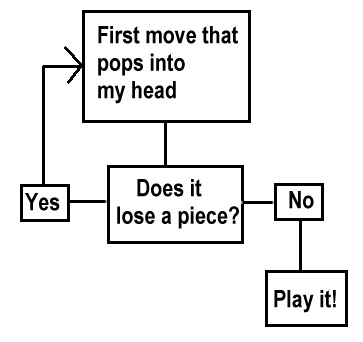
      Abrahams likens the discovery of strategy and technique to his discovery of prose. When he discovered prose, he realized he had speaking in prose all his life. Likewise, he believed many chess players already have some basic understanding of strategy, tactics and ideas but have difficulty expressing themselves on the board. I think this is true. While reading De Groot’s Thought and Choice in Chess I noticed that on occasion lower rated players looked at some of the same moves the GMs did, but usually rejected them out of hand. I thought that was odd and after some thought decided to begin limiting my candidate moves to the first 3-4moves that occurred to me. Over the years I gradually refined this technique as depicted in the following chart.
OK, that’s a joke, but I did notice my game improved. Maybe not a lot, but if you’re like me, any improvement, however slight, rates as a success.
      Technique in Chess is a fun book to read but like all chess books, it will take some dedication but the reward is that you will get some good, practical advice that is bound to improve your game and prepare you for various situations that will arise during the game.
      BTW…if you don’t know descriptive notation I recommend learning it! If you don’t, you are missing out on some great old books. I learned it as a 10-year old, so how hard can it be? If you have to, print out the diagram shown in the Wikipedia article HERE.

Tuesday, August 13, 2013

Not a Chess Book but…

maybe worth reading!


Why do people dodge responsibility when things fall apart? Why the parade of public figures unable to own up when they screw up? Why the endless marital quarrels over who is right? Why can we see hypocrisy in others but not in ourselves? Are we all liars? Or do we really believe the stories we tell? Backed by years of research and delivered in lively, energetic prose, Mistakes Were Made (But Not by Me) offers a fascinating explanation of self-deception—how it works, the harm it can cause, and how we can overcome it.

Review from O Magazine:
      "A revelatory study of how lovers, lawyers, doctors, politicians--and all of us--pull the wool over our own eyes. The politician who can’t apologize, the torturer who feels no guilt, the co-worker who’ll say anything to win an argument--in case you’ve ever wondered how such people can sleep at night, a new book by Carol Tavris and Elliot Aronson supplies some intriguing and useful insights.
      Thanks, in part, to the scientific evidence it provides and the charm of its down-to-earth, commonsensical tone, Mistakes Were Made is convincing. Reading it, we recognize the behavior of our leaders, our loved ones, and--if we’re honest--ourselves, and some of the more perplexing mysteries of human nature begin to seem a little clearer. By the book’s end, we’re far more attuned to the ways in which we avoid admitting our missteps, and intensely aware of how much our own (and everyone’s) lives would improve if we--and those who govern and lead us--understood the power and value of simply saying, ''I made a mistake. I'm sorry.''”

...."and those who govern and lead us--understood the power and value of simply saying, ''I made a mistake. I'm sorry.''” Fat chance!

Friday, August 2, 2013

Chess Tactics for Champions: A step-by-step guide to using tactics and combinations the Polgar way by Susan Polgar


      I’m not a fan of Susan Polgar (or her husband, Paul Truong who supposedly coauthored the book) for reasons I won’t go into, but her activities promoting chess, particularly for women and scholastic players, does have to be lauded.
      In any case, what we have here is yet another tactics book. In the introduction she writes, a tactic is “a tool that helps us gain some kind of advantage. It can lead to material gain or even to checkmate” and she goes on to assert that a player “can get a lot further by being very good in tactics and have only a basic understanding of strategy.” I really must take umbrage with this last statement. Openings have always been a favorite of authors peddling easy wins and these days it’s tactics. I’m not saying tactics aren’t important, but in days gone by, some claimed you couldn’t teach tactics; you were born with the ability to spot them! But guys like Renaud & Kahn, Vukovic, Euwe and Pachman wrote some pretty good books on tactics. Still, back when Botvinnik was “the man” in the chess world, there was a glut of books on strategy and the players who grew up on strategy books by Euwe, Pachman, Fine, et al played some pretty good chess. By the way, I think sometimes lower rated players fail to make a distinction between blunders and tactics. Some players say they are weak tactically and lose pieces and fall into simple mates when in reality they are just overlooking the fact that they are missing obvious replies by their opponents. Hanging your Q to a N fork or overlooking a one move mate is not failing to spot a tactic; it’s just an outright blunder that could have been avoided by looking at the entire board.
      This book consists of an array of exercises, organized by tactical motif and supplemented by examples, but generally descriptions are somewhat lacking. With each topic, she includes a short description of the tactic followed by an example from one of her own games and then jumps right into a set of problems to solve. Some players find the arrangement a major flaw because the tactics are grouped by motif. Personally, I don’t think that's a flaw at all. It's always obvious what kind of tactical solution you are looking for and the ability to recognize patterns and tactical motifs is fundamental for understanding combinations. Her presentation generally makes it fairly easy to find candidate moves that match the theme of the chapter and my understanding is that the Polgar sisters learned by repetition so this format makes sense. But, what would be helpful is a guide to spotting motifs that make combinations possible. C.J.S. Purdy has written some good stuff on this subject and you can download my synopsis, Hints on How to Study Chess for the Most Rapid Improvement here.
      Chapters: Forks and Double Attacks, Deflection and Removing the Guard, Discoveries, Double Checks, Skewers, Trapping Pieces, Decoys, Intermediate Moves, Pawn Promotions, Back Rank, Destroying the Castled King’s Position, King Chase, Two-movers, Three Movers, Four Movers, Game Saving Combinations, Perpetual Checks, Stalemates, Trap and Counter Traps, Sibling Positions, and 25 Famous Combinations
      The back cover says that the book is for "intermediate to advanced" players. That’s probably about right. This definitely shouldn't be your first tactics book if you are rated below, say, 1600, but if you fall between 1600 - 1800, it's worthwhile.

Tuesday, July 9, 2013

The Art of Checkmate


      This book is a classic. It’s not without flaws though, but only a nit picker would complain. The meat of the book is its organization and examples not the prose. According to C.J.S. Purdy The Art of Checkmate by George Renaud and Victor Kahn, former champions of France, is a demonstration of how very suited the French literary tradition is to chess exposition. The close attention to the order and neatness of presentation makes study of most of the French chess writers a pleasure. In this case, a clumsy translation (by W.J. Taylor) has succeeded in making merely delightful what could have been made super-delightful. It is a magnificent exposition of that vital department of chess skill, the mating combination…for the average player, from now on we list this as a MUST book.
     Purdy complained that the translation of this book reaches is an all-time low. Almost every page has sentences that are not translations at all, or even paraphrases but are thoughts of the translator’s. According to the translator, the authors wrote, “The following game was played between two second-rate players who, nevertheless, seem to be pretty well versed in the opening theory.” “Second-rate” is offensive; what the authors actually wrote was, “…amateurs of the second rank—but amateurs of some erudition, for, as we are about to see…” The translator says Taubenhaus was a “second-rate” master.” The authors wrote “maitre de deuxieme plan.” A better translation is, “second-rank master” or “minor master.”
      23 mating situations are classified, including Legal's pseudo-sacrifice, the double check, smothered mate, Greco's mate, the Corridor mate, many others. 127 games by Tartakower, Janowski, Rubinstein, Blackburne, others, illustrating positional maneuvers leading to these mates. Review quizzes test progress.
      People complain about it being in the old descriptive chess notation, but anyone of at least below average intelligence can learn descriptive notation in about 10 minutes. The ability to see patterns is paramount and this book is one of the best at teaching one how to read the board. Go through the patterns again and again and eventually you will finally understand them to the point that when you see them you can apply them in your own games.  In my college days I had trouble factoring binomial equations...just couldn't seem to get it.  Then, I wrote out ONE equation on a slip of paper and whenever I had a couple of spare minutes, I pulled out the paper and worked the problem.  Eventually, after a couple of days and who knows how many time, something clicked and I could work any problem.  Maybe it would work that way with chess tactics, too?!
  

Good Buys

Friday, June 28, 2013

Best Buy on Fritz!


In my opinion the Fritz GUI is absolutely the best and for the price, you can’t beat it.  Some people have a little trouble using it because they are unfamiliar with navigating through it and using all its features, but all the questions on how to use Fritz can be found HERE.

 
Don’t use the Fritz 12 engine that comes with it though.  In fact, don't use any of the Fritz engines. the reason is because other free engines are stronger.  Go to my Blog and search for engines you can download HERE.